
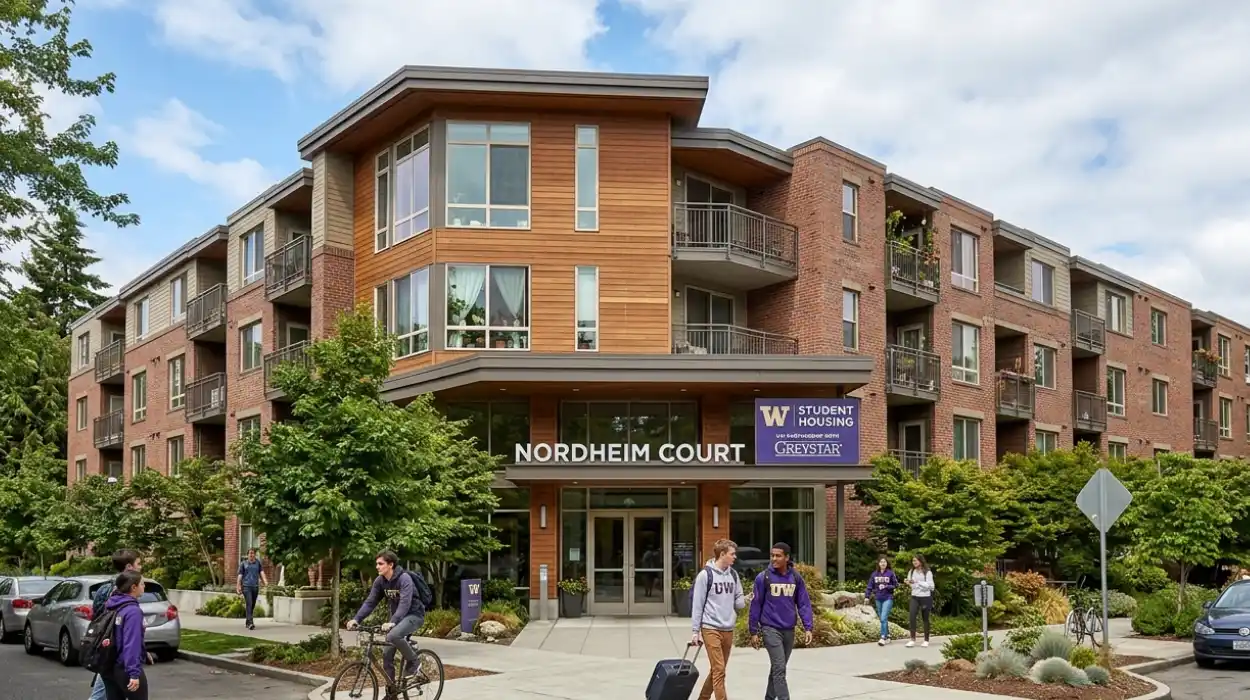
Nordheim Court is a large off‑campus apartment complex in Seattle, Washington, primarily used as housing for University of Washington (UW) students. It sits in the University District, about one mile northeast of the UW main campus, and offers a mix of studio, one‑bedroom, two‑bedroom, and three‑bedroom apartments. The complex is run as student housing through a partnership between UW Housing & Food Services (HFS) and the property management company Greystar.
- What is Nordheim Court, and where is it located?
- Who manages Nordheim Court and under what contract?
- What types of apartments and floor plans are available?
- How does renting Nordheim Court work for UW students?
- What amenities and services are included?
- Who lives at Nordheim Court: primary resident profile?
- How does Nordheim Court compare with other UW student‑housing options?
- What is the safety and security environment like?
- How does Nordheim Court fit into the University District housing market?
- What impact does Nordheim Court have on nearby residents and businesses?
- What are the long‑term housing and policy implications?
What is Nordheim Court, and where is it located?
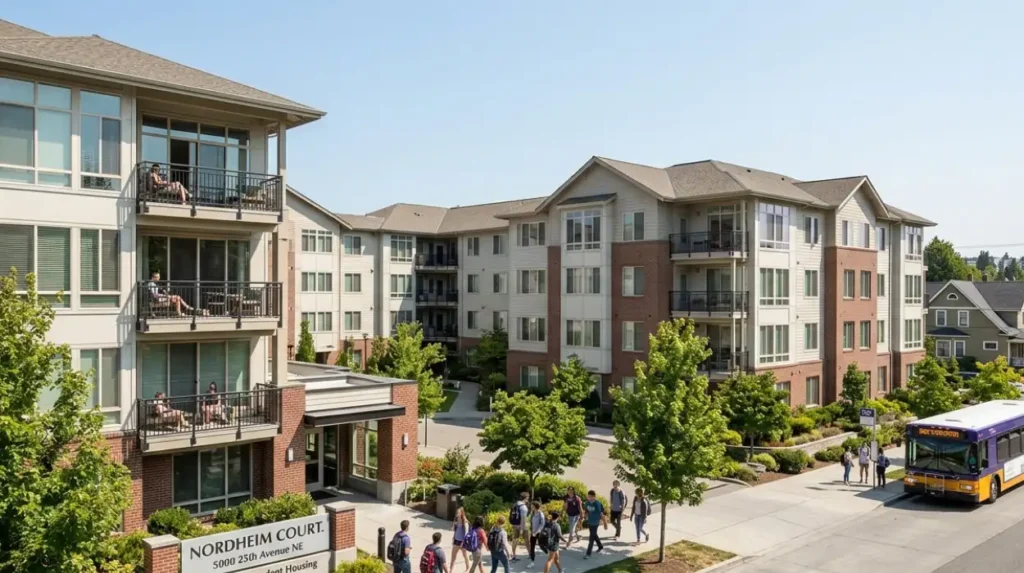
Nordheim Court is a multi‑building apartment complex at 5000 25th Avenue NE, Seattle, WA 98105, serving as off‑campus UW student housing with around 1,000 beds across several buildings. It lies in the University District, just east of the Ravenna‑Bryant neighbourhood and a short bus or walk from the UW campus. The site fronts 25th Avenue NE and branches into internal courtyards, with separate entries for each building.
The campus‑adjacent location gives residents access to UW classes, Husky Stadium, and the Ave (University Way) for shopping, dining, and nightlife. Public transit routes such as Metro buses stop within a few blocks, making it feasible to commute without a car. The complex itself is part of a broader network of UW‑affiliated student‑housing properties, including nearby complexes like Stevens Court and The Junction.
Who manages Nordheim Court and under what contract?
Nordheim Court is managed by Greystar Residential Management, operating under a long‑term contract with the University of Washington Housing & Food Services (HFS) as branded graduate‑student‑oriented housing. HFS controls occupancy, marketing, and leasing policies, while Greystar handles day‑to‑day operations, maintenance, and security. This public‑private partnership model allows UW to offer more beds without owning and operating the entire asset.
The contract is structured as a “managed” arrangement, not pure private‑market housing. That means rent, eligibility rules, and application timelines follow UW‑HFS guidelines, even though the physical asset is on private land. Students apply through the HFS portal, and only enrolled UW students who meet eligibility criteria can lease a unit.
What types of apartments and floor plans are available?
Nordheim Court offers studio apartments plus one‑, two‑, and three‑bedroom units, with most units ranging from roughly 400–1,000 square feet and organised around shared kitchens and bathrooms. Single‑student studios typically have a private bathroom and a small kitchenette area, while multi‑bedroom apartments share a central kitchen and one or more bathrooms. The layouts vary by building, but all units are designed for compact, efficient living.
One‑bedroom units are usually intended for one occupant with a private bedroom and shared common areas. Two‑ and three‑bedroom units allocate one bedroom per resident, with bathrooms and kitchens shared among roommates. Examples of common configurations include:
- Studio: one full‑size bedroom, one bathroom, one kitchen area.
- 1 BHK: similar footprint but sometimes slightly larger, still single‑occupant‑oriented.
- 2 BHK: two bedrooms, one or two bathrooms, one kitchen.
- 3 BHK: three bedrooms, one or two bathrooms, one kitchen.
How does renting Nordheim Court work for UW students?
Rental at Nordheim Court is performed through the UW Housing & Food Services application and lottery system, with contracts running on an annual, 12‑month basis tied to the academic calendar. Students submit housing preferences during the UW‑run application window, then receive assignment and leasing instructions via the HFS portal. Leases typically begin in late summer, align with the fall‑quarter start date, and end in summer, with move‑out dates set by HFS.
Rent is paid monthly and includes utilities such as water, electricity, and high‑speed internet. Some agreements may also bundle limited cable or streaming‑friendly internet capacity. Parking is available for an additional fee, with reserved or unreserved spaces in the on‑site garage or adjacent lots. Students must meet UW‑HFS residency and enrolment requirements, and international students are usually eligible if they are degree‑seeking and enrolled full‑time.
What amenities and services are included?
Nordheim Court residents have access to on‑site amenities such as a fitness centre, package lockers, laundry rooms, and controlled‑access buildings, plus proximity to UW campus resources and city services. The fitness area includes cardio equipment and basic weight machines, and the laundry rooms are distributed across multiple buildings rather than concentrated in one hub. Common areas such as lounges or study rooms are limited but grow when students combine UW‑provided lounges nearby.
Each building generally has secure entry with key fob or card access, and 24‑hour basic security monitoring is coordinated between Greystar staff and UW‑HFS. Garbage and recycling are collected on a regular schedule, and maintenance tickets can be submitted through the HFS or Greystar portals, with most routine issues addressed within working‑day timeframes. The complex also sits within the Seattle Police Department’s jurisdiction, so patrols and emergency response follow city protocols.
Who lives at Nordheim Court: primary resident profile?
Nordheim Court is preponderantly occupied by University of Washington students, with a strong emphasis on graduate and upper‑division undergraduates due to its off‑campus positioning and higher‑density units. Census‑style data from HFS indicates that most residents are aged 20–30, single, and enrolled at least half‑time in degree programmes. The population includes a mix of domestic and international students, with particular numbers from Asia, Europe, and North America.
Because leases run on an academic‑year basis, the population turns over once per year, with move‑in concentrated in August–September and move‑out in June–July. This cyclical pattern affects neighbourhood congestion, parking demand, and local business activity around the University District. The gender split is roughly balanced, with roommates typically sharing the same building or floor for ease of coordination.
How does Nordheim Court compare with other UW student‑housing options?
Nordheim Court is one of several UW‑affiliated off‑campus complexes; compared with campus‑edge options like Stevens Court or The Junction, it offers more bedrooms per building but fewer on‑site community spaces. On‑campus housing such as Bailey‑Hastings or McMahon tends to have stricter social rules and more integrated dining, whereas Nordheim Court gives more autonomy and a “true apartment” feel. Rent per bed at Nordheim Court is usually slightly lower than premium‑status on‑campus residence halls but higher than some private‑market apartments that lack utilities and internet.
Key differences include:
- On‑campus halls: more dining facilities, more structured programming, less freedom in layout.
- Nearby private apartments: no utilities always included, often no formal partnership with UW.
- Other UW‑managed off‑campus sites: some (for example, Stevens Court) place more emphasis on shared lounges and study rooms per building.
Nordheim Court therefore serves students who want a balance of UW‑affiliated stability and semi‑independent living, with access to campus but not bound to traditional dormitory rules. It is most attractive to those who prioritise having a private bedroom with a lockable door and shared kitchen, rather than communal corridor bathrooms.
What is the safety and security environment like?
Nordheim Court operates under a blended security framework of on‑site building controls, UW‑HFS protocols, and Seattle Police Department coverage, with incident levels broadly in line with urban, student‑heavy neighbourhoods. Buildings use key fobs or card access, and package lockers reduce the risk of package theft. Security‑related staff or front‑desk coverage are limited; residents rely largely on neighbour‑watch practices and HFS guidance.
In May 2026 a fatal stabbing occurred in a laundry room in Building 7, with a 19‑year‑old UW student killed and a suspect still at large as of subsequent reporting. This incident highlighted vulnerabilities in common areas and prompted renewed discussion of lighting, surveillance, and response‑time protocols at Nordheim Court and similar complexes. UW‑HFS and Greystar can adjust security in response to such events, but ultimate policing authority lies with SPD.
Long‑term safety is therefore a function of both management‑level controls (cameras, access systems, maintenance) and individual behaviours (locking doors, using well‑lit routes, avoiding isolation at night). Residents are encouraged to report suspicious activity to building‑level staff and to use the UW‑HFS emergency‑contact channels during campus‑related incidents.
How does Nordheim Court fit into the University District housing market?
Nordheim Court sits in a high‑demand, low‑vacancy segment of the University District, where student concentrations push rents above citywide averages and keep turnover low. The University District is designated as a “high‑density education” zone, with zoning that permits higher‑rise apartment buildings and mixed‑use development near UW. This has increased the supply of student‑oriented housing but also intensified competition for parking and transit access.
Median rent‑per‑bed in Nordheim Court‑type UW‑managed complexes is typically 10–20% above the University District average for private‑market units of similar size, once utilities and internet are included. That premium reflects the guaranteed UW affiliation, bundled services, and predictable academic‑year terms. In contrast, independent landlords in the area may offer lower base rents but require separate utility contracts and shorter, more flexible leases.
From a planning perspective, Nordheim Court contributes to the city’s goal of intensifying housing near major employment and education hubs. It also raises local concerns about parking congestion, noise after midnight, and strain on public transit capacity during peak student move periods.
What impact does Nordheim Court have on nearby residents and businesses?
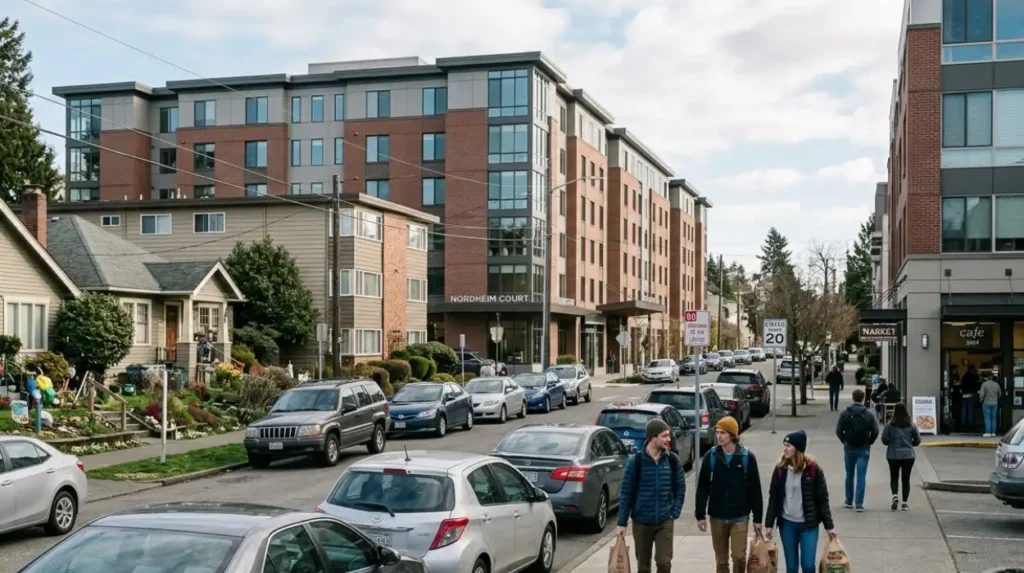
Nordheim Court’s large student population affects nearby residential streets, parking availability, and local commercial activity, with both positive and negative externalities. On the positive side, steady foot traffic supports nearby restaurants, cafes, grocery stores, and convenience shops, especially along the Ave and 25th Avenue NE. Student spending can increase local tax revenue and justify longer business hours or expanded services.
On the negative side, residents in adjacent low‑density blocks report higher competition for street parking, occasional late‑night noise, and increased pressure on emergency services during peak move‑in and move‑out weeks. The stabbing incident in May 2026 also heightened community anxiety about safety in shared common areas, even though the overall crime rate per capita remains within the range of comparable urban neighbourhoods. Community‑engagement meetings between UW‑HFS, Greystar, SPD, and local neighbourhood councils are one channel for addressing these issues.
What are the long‑term housing and policy implications?
Nordheim Court exemplifies a durable trend toward off‑campus, managed‑private student housing as universities seek to expand beds without constructing new dormitories on constrained campuses. This model allows UW to maintain occupancy control and student‑support services while outsourcing capital risk to property‑management firms. Over time, such arrangements may reshape neighbourhoods like the University District into high‑density “student quarters,” with implications for zoning, parking regulations, and public‑safety planning.
For the residents, the implication is more predictable housing contracts and bundled services, but less traditional campus‑dorm life. For city planners, the challenge is balancing growth in student housing with the needs of long‑term residents, sustainable transportation, and fair‑use of public infrastructure. Nordheim Court will likely continue to evolve in response to student demand, safety reviews, and land‑use policy changes, remaining a key node in Seattle’s broader student‑housing ecosystem.
What is Nordheim Court?
Nordheim Court is a large off-campus apartment complex in Seattle, Washington, primarily used for University of Washington student housing. It is located at 5000 25th Avenue NE in the University District and offers studio, one-bedroom, two-bedroom, and three-bedroom apartments for UW students.