Key Points
- A lone protester, Guido Reichstadter, spent five days on top of the Frederick Douglass Memorial Bridge in Washington, DC, before coming down on Wednesday morning.
- Reichstadter, an activist from Florida, was protesting the war in Iran, President Donald Trump’s policies, and the advancement of artificial intelligence.
- He told reporters and in social‑media posts that he had run out of water two days before he descended and intended to come down on Wednesday.
- Metropolitan Police Department (MPD) officers took him into custody after he climbed down; the bridge was closed for roughly 30 minutes during the operation.
- Authorities and local media reported that Reichstadter gave several statements over the course of his protest, including warnings that he expected to face jail time once on the ground.
Washington, DC (Evening Washington News) May 5, 2026 – A five‑day protest by activist Guido Reichstadter atop the Frederick Douglass Memorial Bridge ended on Wednesday when he climbed down and was taken into police custody, according to multiple news outlets.
- Key Points
- How did the protester get down from the bridge?
- What was the protester’s message and motive?
- How long did the protest last and what was the traffic impact?
- What statements did the protester make before coming down?
- How did authorities respond during the standoff?
- What happened immediately after he climbed down?
- Background of the development
- Prediction: How this development can affect the particular audience
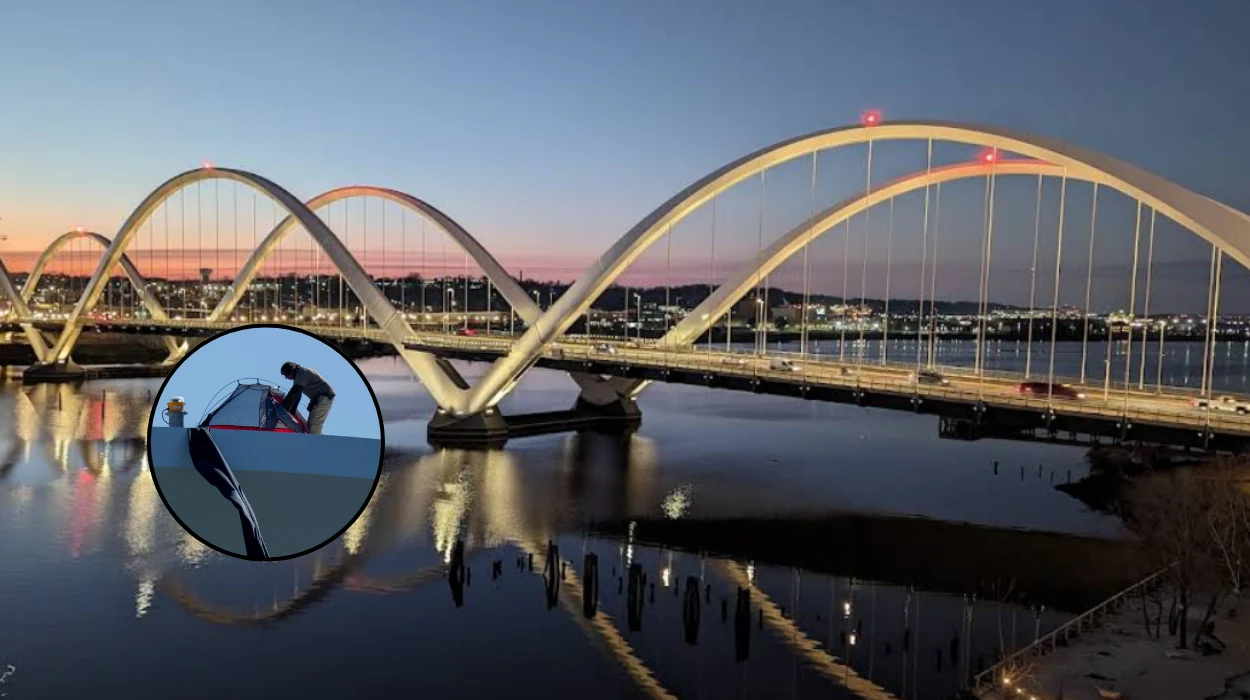
Reporting for The Washington Examiner, a journalist covering the story wrote that Reichstadter, identified as a Florida‑based activist, apparently climbed the bridge’s 170‑foot arch on Friday to protest the Iran war, President Donald Trump’s policies, and the expansion of artificial intelligence.
As reported by USA Today, the protester had been visible on the bridge’s elevated structure for several days, with police and traffic officials advising drivers to avoid the area and to use alternative routes over the Anacostia River.
How did the protester get down from the bridge?
According to The Washington Examiner, Reichstadter announced on social media that he had run out of water on Sunday and planned to descend on Wednesday morning. In a post on X (formerly Twitter), he reportedly wrote:
“I’ll probably be going to jail for a while when I get down. I’ll be handing off this account and hopefully we can stay in touch.”
The same outlet noted that the entire Frederick Douglass Memorial Bridge was closed for about 30 minutes as authorities assisted Reichstadter in climbing down to the ground. The Metropolitan Police Department later confirmed that he was in custody and would face charges related to the protest, though exact charge details were still being evaluated at the time of reporting.
What was the protester’s message and motive?
Newsweek, citing social‑media updates and imagery shared during the protest, reported that Reichstadter set up a small tent on the bridge and used the platform to speak out against the war in Iran and what he described as the unchecked advancement of artificial intelligence.
Freelance journalist Andrew Leyden, whose photos and footage were cited by Newsweek, documented Reichstadter removing his shoes and socks to grip the slick bridge surface, as well as police negotiators using a megaphone to urge him to come down.
Local Washington‑area outlets, including Fox 5 DC, noted that Reichstadter is known for previous high‑profile protests, including a 2022 climb of the same Frederick Douglass Memorial Bridge after the Supreme Court’s decision to overturn Roe v. Wade.
How long did the protest last and what was the traffic impact?
As reported by The Washington Examiner, Reichstadter’s latest protest lasted five days, from Friday afternoon until his descent on Wednesday morning. During that time, the Metropolitan Police Department and the District Department of Transportation coordinated closely to manage traffic and safety, periodically closing the bridge and rerouting vehicles.
Footage broadcast by local TV stations and shared on YouTube showed live coverage of the protester on the bridge, with anchors noting that snipers and drones had been deployed in the surrounding area as part of the security and monitoring operation.
What statements did the protester make before coming down?
In the hours leading up to his descent, Reichstadter communicated several times via social media. According to The Washington Examiner, he said he had run out of water on Sunday and indicated that Wednesday would be the day he came down.
A post attributed to him on X, quoted without editorial commentary in several outlets, included the expectation that he would face jail time after being taken into custody.
How did authorities respond during the standoff?
Reporting for USA Today, journalists noted that DC police classed the situation as a “barricade” incident and urged the public to avoid the bridge area. The Metropolitan Police Department said its priority was to remove Reichstadter safely and to prevent any injury to the protester or to motorists.
Local news partner WUSA9 reported that officers had been monitoring Reichstadter’s position throughout the protest, maintaining a presence on the bridge approaches and nearby roads.
What happened immediately after he climbed down?
Once Reichstadter reached the ground, The Washington Examiner stated that the bridge was reopened after about 30 minutes, restoring normal traffic flow over the Anacostia. The newspaper also reported that the MPD had been in contact with him prior to the descent and confirmed his arrest and processing into custody following the operation.
DC‑area broadcaster Fox 5 DC linked the current incident to Reichstadter’s earlier 2022 protest on the same structure, noting that he had spent more than 24 hours atop the bridge then before being taken into custody.
Background of the development
The Frederick Douglass Memorial Bridge spans the Anacostia River in Washington, DC, and carries major traffic between the southeast and southwest quadrants of the city. Over the past several years, the structure has been used by at least one high‑profile activist, Guido Reichstadter, as a raised platform for protest.
In June 2022, Reichstadter climbed the bridge following the Supreme Court’s overturning of Roe v. Wade, according to reports from Fox 5 DC and Newsweek. Local authorities closed the bridge for hours that year while police negotiated with him and eventually brought him down; he was later arrested and charged.
The 2026 incident echoes that earlier event in several key respects: the same bridge, an extended time on the structure, and a focus on national‑level political issues such as war and technology policy. In both cases, the Metropolitan Police Department and DC transportation agencies have described their approach as prioritising safety for the protester and the public over speed of removal.
Prediction: How this development can affect the particular audience
For Washington, DC residents and commuters, this incident underscores the potential for prolonged transport disruption whenever a protest occurs on a critical bridge or roadway. The repeated use of the Frederick Douglass Memorial Bridge by the same activist suggests that authorities may review their protocols for responding to elevated‑location protests, including how and when to close or restrict access to major arteries.
For local media outlets and national news organisations, the protest offers a visible, visually dramatic way to cover complex policy debates—such as the war in Iran and the regulation of artificial intelligence—by tying them to a single, high‑profile action. This can increase public awareness of those issues but may also shift attention away from broader policy discussions towards the individual protester’s tactics and legal fate.
For future activists considering similar actions, the fact that Reichstadter has been arrested after both his 2022 and 2026 climbs may serve as a caution that such stunts commonly lead to criminal charges and detention, regardless of the message or cause. At the same time, the extensive coverage of his protests may also encourage others to seek visibility by targeting well‑known infrastructure in the nation’s capital.
For law‑enforcement and public‑safety planners in Washington, the repeated incidents on this bridge may prompt a review of how best to balance protest‑rights protections with the need to keep traffic moving and to avoid public‑safety risks when a person is entrenched at a hard‑to‑access location.